Workplace Strategy vs Office Design
Most businesses hire a designer when what they actually need is a diagnosis. The two conversations feel similar because they both end in a floor plan, but they start from entirely different questions, and skipping the first one is how organisations end up with beautifully designed offices that solve the wrong problem.
Office design answers “what should this space look like.”
Workplace Strategy answers “what does this space need to do.”
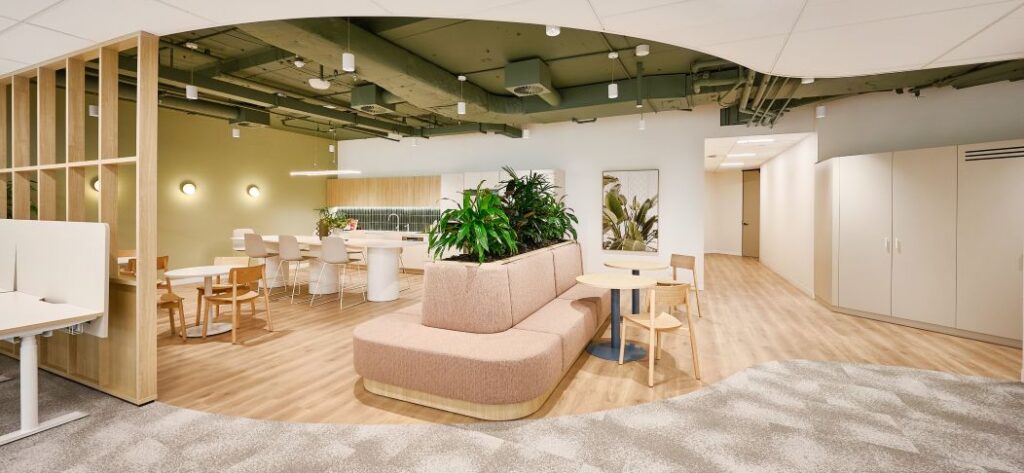
Design strategy deals with the physical and spatial decisions in a project: where the amenities sit, how the floor is zoned, what materials and finishes carry the brand through the space. Effective workplace zoning, dividing a floor into focus, collaboration, social and confidential areas matched to how a team works, sits inside this design layer. Design strategy assumes the groundwork already exists; it answers how to build the thing, not what the thing should be.
The workplace strategy process sits a level above that. It’s how an organisation plans, governs and evolves its relationship with space over time, in service of business outcomes, culture and people performance. This isn’t a new idea dressed up in consulting language. A foundational 2005 paper in the Journal of Corporate Real Estate described workplace strategy as the dynamic alignment of an organisation’s work patterns with its work environment, a definition that has held up because the underlying problem hasn’t changed: businesses keep briefing designers before they’ve answered the harder question of how their people actually work.
What a Workplace Strategy engagement usually involves
A Workplace Strategy engagement starts with data collection and stakeholder workshops. PMG structures this work across three stages. Sense looks at how people use space today and where that use is heading, built on data, stakeholder workshops and behavioural observation. Shape translates those findings into a workplace strategy and spatial concepts aligned with business priorities. Steer carries that thinking through governance and strategic guardrails, so property and design decisions stay aligned with the original brief once other people are making day-to-day calls on the project.
The scope varies with where a business sits in its property cycle. A full property strategy typically runs well ahead of a lease decision, informing both the property and the design brief. A design-focused strategy picks up once a building is selected, aligning leadership before the design phase starts rather than after several expensive rounds of revision. This is the same structure behind office fitouts in Brisbane and Adelaide that PMG runs today, scaled to the size of the portfolio rather than the city. Once the strategy is set, PMG’s design and delivery team carries it through into layout, zoning and finishes.
Is workplace strategy the same as change management?
No, though the two overlap. Change management deals with how people adapt to a new way of working: communication plans, training, adoption support.
An organisation can run a technically flawless change management program around a workplace strategy that was never validated against how the business really operates, and the rollout will still struggle, because the underlying plan didn’t match reality in the first place.
The most common trigger for this work is a lease expiring within the next twelve to thirty-six months, the window PMG’s Workplace Strategy engagements typically begin in to leave enough runway for a proper decision. That deadline forces a decision either way. A structured stay vs go assessment turns it into an informed one, testing how much space the organisation needs and what kind of space would serve it, before a single square metre gets recontracted. For a Sydney office fitout, that window often opens even earlier given how tight the market is running.
The takeaway
A well-designed office without a strategy behind it can still fail the business it was built for, because good execution doesn’t fix a flawed starting brief. Workplace Strategy is the fact-finding step that makes sure the office being designed is the one the organisation needs, whether that’s a straightforward Melbourne office fitout or a national portfolio consolidation, before a floor plan takes shape.
Frequently Asked Questions
What is the difference between workplace strategy and office design?
Workplace Strategy determines how an organisation should use space to meet its business goals, while office design applies that thinking to physical layout, materials and finishes. Strategy comes first and design follows.
What does a workplace strategy consultant do?
A workplace strategy consultant collects occupancy data, runs stakeholder workshops and analyses how a business actually works, then translates those findings into recommendations for space, policy and layout.
Why does a business need a workplace strategy?
A workplace strategy prevents costly design decisions built on assumption rather than evidence, and is especially valuable ahead of a lease expiry, merger, relocation or hybrid work policy change.
Is workplace strategy the same as change management?
No. Change management supports people through a transition, while workplace strategy determines what that new way of working should be based on data and stakeholder input.