2026 Insights on Building a High Performing Team

Most business leaders say technology had the biggest influence on their team’s performance this year. Yet when asked what matters most to their people in the office, the overwhelming answer was culture and connection.
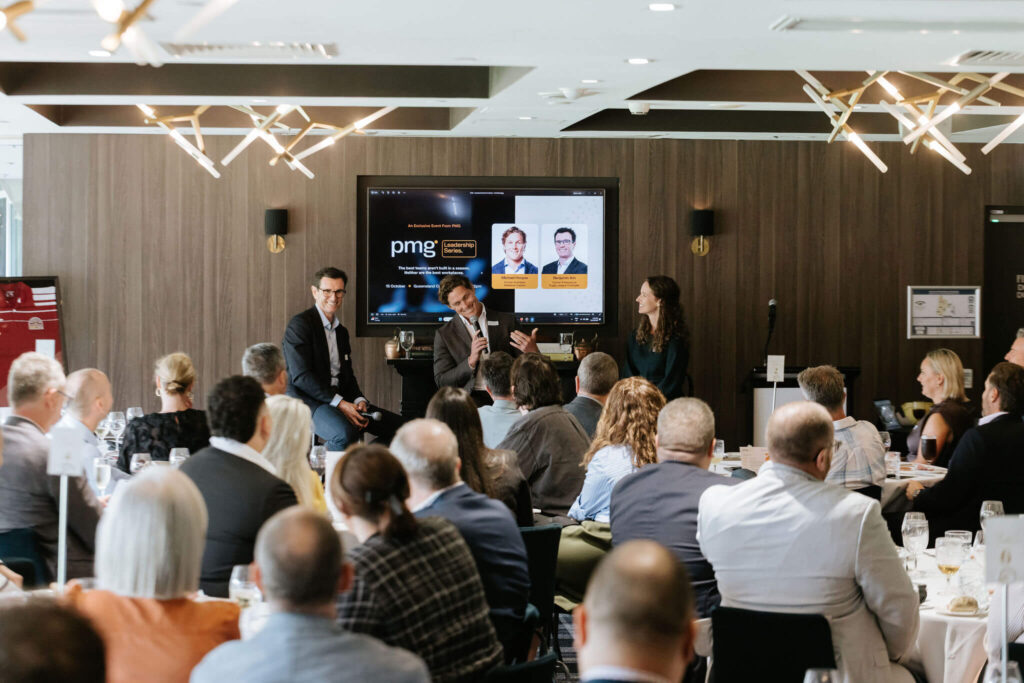
That distinction matters. Organisations can invest in better tools, restructure teams and refine their operating models, but performance also depends on how people experience their working environment and how effectively leaders bring them together. Findings from the first instalment of the PMG Leadership Series event offer a timely perspective on where those challenges intersect, and what leaders should consider when building high-performing organisations.
Technology may drive performance, but leadership shapes the conditions
More than half of respondents, 56%, identified technology or tools as having the biggest impact on their team’s performance this year. Leadership change followed at 26%, with culture shift at 13% and the physical environment at 5%.
The results reflect the immediate pressures facing business leaders. Technology is visible, measurable and often directly connected to operational output. Changes to leadership can also reshape priorities, decision-making and the way teams work together.
The comparatively low selection of culture and the physical environment deserves closer consideration. These factors can influence performance over a longer period, making their contribution harder to isolate from the tools and management decisions that attract more immediate attention.
A new platform can improve the speed of a task. A change in leadership can redirect a team. The conditions in which people work, however, influence how effectively those changes translate into everyday behaviour. The survey raises an important question for leaders: are they measuring the most visible drivers of performance while overlooking some of the conditions that sustain it?
The biggest cultural barriers sit with leadership and connection
When respondents were asked about the biggest barrier to building a high-performing culture, remote or hybrid disconnect ranked first at 38%. Leadership alignment followed closely at 36%, while 21% selected unclear purpose or direction. Only 5% identified the physical environment as the primary barrier.
These findings point towards a challenge that technology alone cannot resolve. Organisations may have the platforms and policies required to support hybrid work, but the presence of those systems does not guarantee that employees feel connected to their colleagues or aligned with the organisation’s direction.
Remote and hybrid arrangements change how people encounter information, develop relationships and understand the expectations around them. In an office, employees may pick up context through conversations they were not formally invited to join. Distributed teams need deliberate ways to create those opportunities, while ensuring people understand how their contribution connects to the wider organisation.
Leadership alignment is equally important. When leaders communicate competing priorities or model different expectations, employees are left to interpret what matters most. A strong culture requires consistency between what leadership says, what managers reinforce and what employees experience in their day-to-day work.
Connection and alignment are closely related, but they require different responses. Leaders need to establish a clear direction, then create the conditions for people to understand it, participate in it and work towards it together.
Why culture and connection matter most in the office
When asked what matters most to their people when it comes to the office, 67% of respondents selected culture and connection. Flexibility ranked next at 18%, followed by collaboration space and quiet focus space, each at 8%.
This result offers a useful counterpoint to the assumption that workplace strategy is primarily a question of desks, attendance and space allocation. For the leaders surveyed, the office’s most important contribution was associated with the experience it creates for people.
That has direct implications for workplace decisions. An office can provide enough desks and meeting rooms to accommodate employees without making it easier for them to build relationships or work effectively together. Equally, a workplace designed around collaboration can fall short if employees cannot find somewhere to concentrate when their work demands it.
The distinction is between providing a space and understanding what people need that space to support. Culture and connection may be the leading priority, but the physical environment still needs to accommodate the individual work that makes collaboration productive.
Flexibility also matters. Its second-place ranking suggests that leaders recognise the need to give people some control over how they work. The challenge is to create an environment that supports different activities and working preferences without weakening the shared experience that brings people together.
Leaders recognise the workplace’s influence, but understanding it requires deeper investigation
One of the clearest findings was the perceived importance of the physical workplace to business performance. A combined 95% of respondents described its impact as either very significant (64%) or somewhat significant (31%). Only a small minority selected minor or no significance.
This creates an interesting contrast with the earlier question about performance drivers, where only 5% selected the physical environment as the factor with the biggest impact on their team that year.
These responses measure different things. One asks respondents to identify the leading influence on recent performance; the other asks them to assess the workplace’s overall significance. Taken together, they suggest that leaders can recognise the workplace’s importance without necessarily seeing it as the most immediate driver of results.
That distinction matters when organisations make property and workplace decisions. Leaders might acknowledge that the office affects performance, then base a redesign primarily on occupancy data, desk ratios or a reduction in property costs. Those measures provide useful information, but they cannot explain every reason people choose to attend, avoid particular spaces or struggle to complete certain tasks.
A workplace’s effectiveness depends on how its physical characteristics interact with people’s behaviour. Acoustics, privacy and the mix of spaces matter, as do social expectations, individual preferences and the nature of the work being undertaken. The same office can feel productive to one employee and distracting to another, depending on the activity and circumstances.
Understanding these relationships requires more than a floor plan or utilisation dashboard. It calls for evidence about how people experience the workplace, supported by observation of how they use it.
Human geography offers a different way to understand workplace performance
Despite the strong recognition of the workplace’s importance, 59% of respondents had never heard of human geography as a discipline. A further 33% were somewhat familiar with it, while 8% described themselves as very familiar.
That gap creates an opportunity to broaden the conversation about workplace strategy. Human geography examines the relationship between people and place, including how environments shape behaviour and how people assign meaning to the places they inhabit.
Applied to the workplace, this perspective helps explain why two spaces with similar layouts can produce different experiences. A room might look suitable for confidential conversations on a floor plan, yet leave occupants feeling exposed because they cannot see who is nearby. A busy office might feel comfortable when it offers a useful mix of settings, while a less occupied floor can feel crowded if its layout creates competing demands on the same spaces.
The practical value comes from combining quantitative evidence with qualitative investigation. Occupancy data can show where people are working; observation and employee feedback can help explain why, and whether the environment supports the activities taking place there.
As artificial intelligence makes it easier to process large volumes of workplace data, understanding the context behind that data becomes increasingly important. The advantage lies in identifying the human factors that a dashboard cannot explain on its own.
Better workplace decisions begin with better questions
PMG’s survey captures the views of a group of business leaders at a particular moment. With 39 participants, the findings should be treated as a snapshot of the perspectives represented at the event, rather than a measure of the wider business community.
Even within that scope, the results reveal a valuable tension. Leaders identify technology as the leading influence on recent team performance, see connection and leadership alignment as major cultural challenges, and place considerable importance on the physical workplace.
For organisations reviewing their workplace, the next step is to investigate how those factors interact within their own business. That means understanding what employees need to do, what currently helps or hinders them, and how the environment can better support the organisation’s priorities.
A high-performing workplace starts with an evidence base that reflects both the needs of the business and the experiences of its people. The quality of the decisions that follow depends on how deeply leaders understand the relationship between the two.