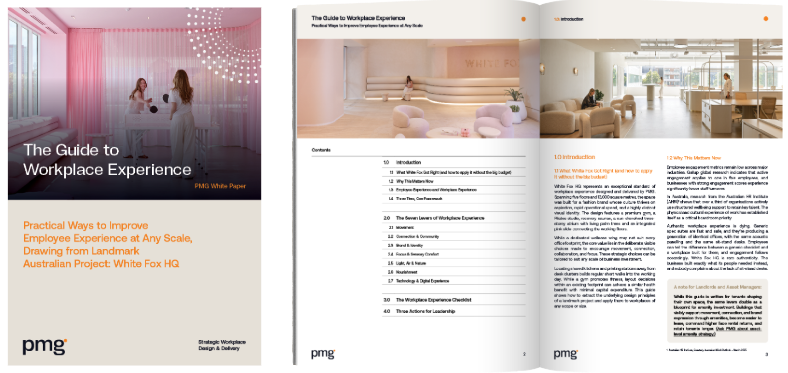
The Guide to Workplace Experience
This guide gives People & Culture leaders and executive teams a practical answer to what workplace experience means and how to improve it inside any organisation. Built around seven core levers and grounded in the landmark White Fox HQ project, it shows how movement, connection, and sensory comfort combine to lift daily performance. Download the guide to gain a repeatable model for improving employee experience, regardless of budget or organisational size.
Why This White Paper is Essential
The Guide to Workplace Experience helps you:
- Define What Workplace Experience Means for Your Organisation: Move past vague wellbeing initiatives and work from a clear model built on seven measurable levers, from movement to technology.
- Improve Employee Experience at Any Budget: Identify which lever delivers the highest impact for your business size, whether you are planning a major relocation or refining everyday operations.
- Give People & Culture a Practical Framework: Equip People & Culture and workplace experience teams with a self-audit model connecting each lever to specific policy, design, and operational actions.
- Learn From a Landmark Case Study: See how White Fox HQ turned workplace experience principles into a built environment that reflects brand and culture.
What You’ll Get Inside:
- Actionable strategies matched to your situation: A three-tier framework built around where your organisation actually sits, from the rare, fully custom scale of White Fox HQ, to funded Opportunity moments like a relocation or portfolio review, through to Everyday, policy-driven changes led by your existing team.
- Seven levers of workplace experience, grounded in recognised standards: A practical breakdown of Movement, Connection & Community, Brand & Identity, Focus & Sensory Comfort, Light, Air & Nature, Nourishment, and Technology & Digital Experience, drawing on frameworks including the WELL Building Standard, Green Star, and NABERS.
- Three direct actions for leadership: address the largest operational gap first, align tier selection with real business triggers, and treat workplace experience as an analytical strategy instead of a design afterthought.
Expected Outcomes:
- Higher Retention: Reduce turnover linked to poor workplace and employee experience, keeping senior talent and technical specialists engaged for longer.
- Stronger Engagement and Focus: Lower distraction and burnout by addressing sensory comfort and movement, lifting daily productivity across teams.
- Smarter Capital Allocation: Direct budget toward the lever with the greatest impact instead of spreading investment across seven priorities at once.
- Aligned Leadership: Give your executive team a shared, top down framework for workplace decisions, reducing friction between People & Culture, property, and operations.
The Business Case:
When workplace experience is left to generic design and policy alone, the cost shows up in engagement, alignment, and retention:
77%
Of occupiers now see improved amenity and services as essential to office strategy, raising the bar for what employees expect from the workplace.
85%
Of business leaders find maintaining team alignment harder in hybrid environments, a direct signal that space and technology need to close the gap.
21%
Loneliness reported by hybrid employees, higher than colleagues working fully in the office.